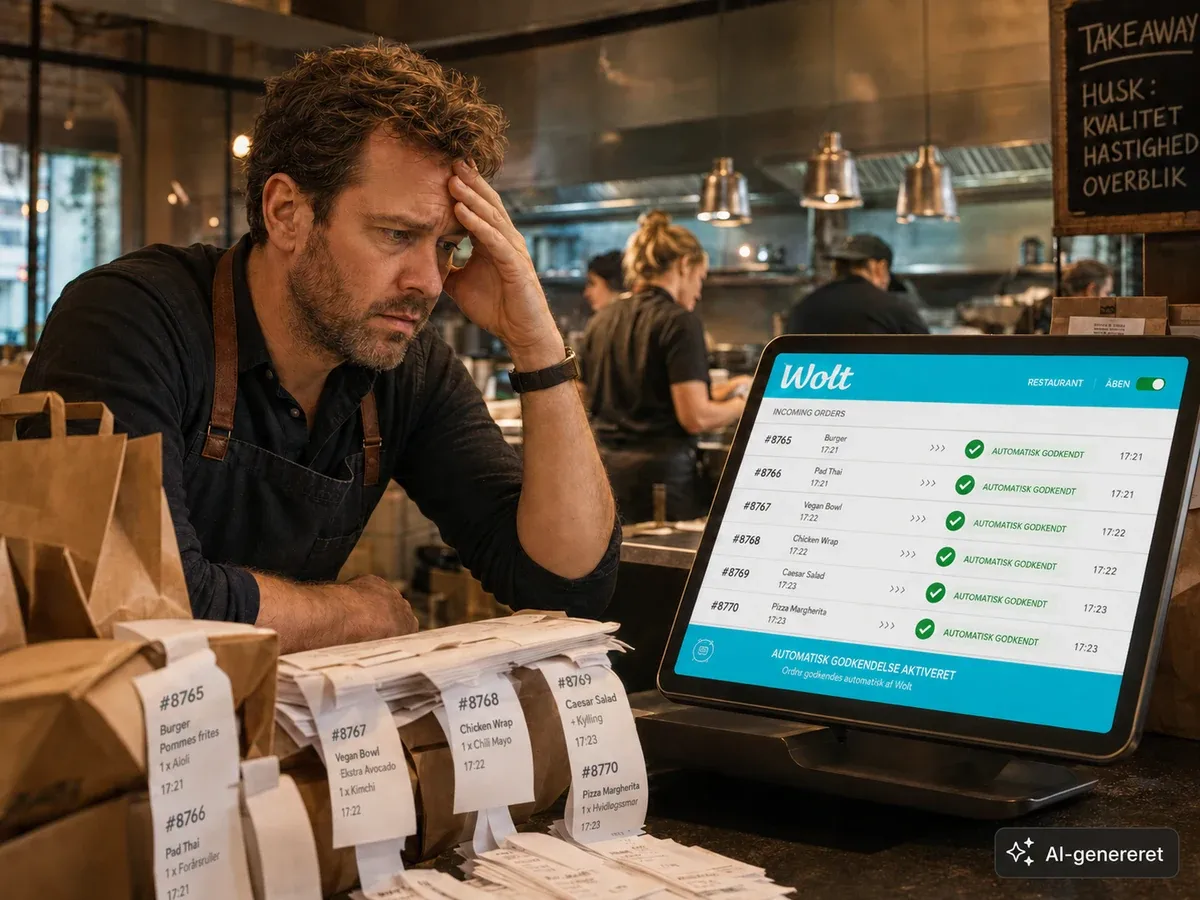
Wolt has informed restaurants that automatic order acceptance will be enabled on their accounts. New Wolt orders will therefore be accepted automatically as soon as they arrive.
Wolt highlights benefits such as fewer missed orders, faster service and less manual work. On the surface, it sounds like a practical improvement. But restaurants receiving orders from several sales channels should look more closely at how automatic acceptance affects daily operations.
When the kitchen has reached capacity
Every kitchen has a limit to how many orders it can handle at once. That limit depends on staffing, equipment, space and the complexity of the orders. During busy periods, capacity may therefore be reached before staff have had an opportunity to assess the overall workload.
With automatic order acceptance, a Wolt order is accepted before the restaurant necessarily has a full overview of orders from its own website, the phone or other takeaway providers. This can make it more difficult to prioritise according to the kitchen’s actual situation.
The risk of uneven prioritisation
If Wolt orders automatically fill the system, the restaurant may have to:
- reject orders from other sales channels
- extend delivery times for its own customers
- temporarily close its own takeaway channel
- or try to produce more orders than the kitchen can realistically handle
This does not necessarily mean that automatic order acceptance is a bad solution. It does mean, however, that the restaurant should consider whether the feature suits its workflows and the way orders are distributed throughout the day.
What should the restaurant consider?
The most important thing is to look at the entire order flow, not just one platform at a time. When several channels compete for the same kitchen capacity, maintaining an overview and making decisions that work for the whole business becomes essential.
Restaurants should therefore examine how automatic order acceptance affects waiting times, staffing and the ability to accept orders from their own customers. It may also be relevant to clarify with Wolt Support how the feature can be disabled if it does not suit the operation.
Automation should support operations, not control them
Automated processes can help when they reduce manual work without removing the restaurant’s ability to prioritise. But when orders arrive from several sales channels, technology should support the kitchen’s capacity rather than determine which orders get a place.
For each restaurant, the question is therefore not only whether an order is accepted automatically. It is also whether the restaurant retains control of its overall order flow and can deliver a good experience to every customer.