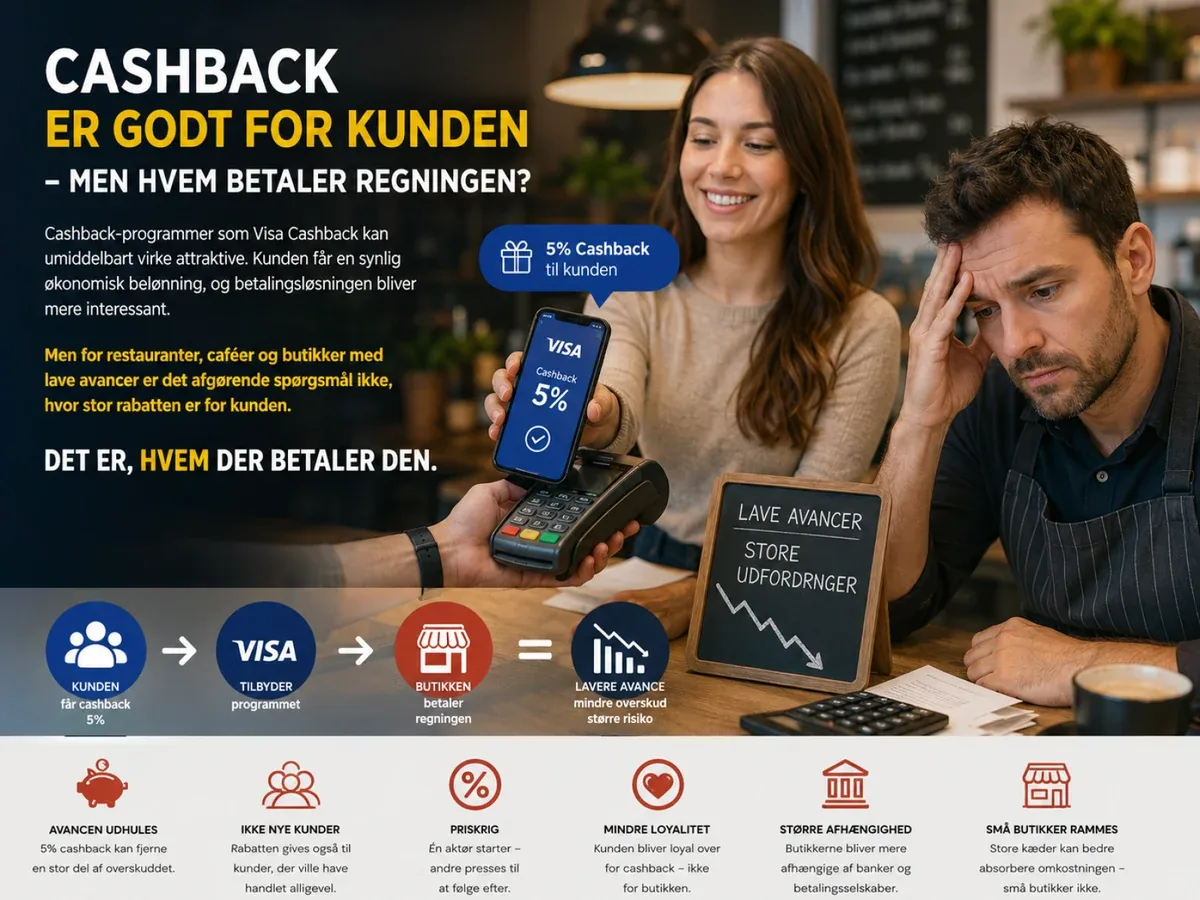
Cashback programmes such as Visa Cashback may initially seem attractive. The customer receives a visible financial reward, and the payment solution becomes more appealing. But for restaurants, cafés and retailers with low margins, the crucial question is not how large the customer’s discount is. It is who pays for it.
A 5% discount can have a major impact
Imagine a restaurant with revenue of DKK 100. Ingredients, wages, rent, energy and other expenses can quickly amount to around DKK 85, leaving DKK 15 before tax.
If the restaurant also pays DKK 5 in cashback and around DKK 1–2 in card fees, the result falls to around DKK 8–9. This means that roughly 35–45% of the profit disappears even though sales are exactly the same.
Cashback does not necessarily create new sales
The greatest challenge is that cashback is also given to customers who would already have bought from the restaurant. A customer who previously paid DKK 500 still pays DKK 500 after cashback is introduced. The difference is that the restaurant now has to give up DKK 25 of that amount.
Without more guests or a higher average order value, cashback effectively becomes a permanent discount on existing sales. For a restaurant with annual revenue of DKK 10 million, 5% cashback amounts to DKK 500,000. If profit before tax is DKK 700,000, it could fall to around DKK 200,000 in a simplified example.
Risk of a price war and less loyalty
When one chain offers cashback, others may feel pressured to follow. This can lead to lower margins, higher prices, fewer employees or less investment in service and quality. Small local businesses are often affected the most because they have less scope to negotiate fees or offset losses through high volume.
Cashback can also shift customer loyalty away from the restaurant. The customer becomes more loyal to the bank, Visa or the cashback platform and may switch if another provider offers a slightly larger reward. At the same time, large international providers gain more influence over which businesses are highlighted and which terms they must accept.
The crucial question
Cashback is not necessarily a bad idea. But it should only be financed by the restaurant if it demonstrably generates enough additional revenue to cover the cost. Otherwise, the business is giving a discount to customers who already visit.
- Does the programme attract new customers?
- Does it encourage guests to spend more?
- Is the cost lower than the additional profit?
Before agreeing to cashback, you should therefore calculate its true effect on the bottom line. Contact Lenius if you would like to work more systematically with your restaurant’s finances and decision-making.